
About
Overview of the SR-DDRC
The Southern Regional Drug Data Research Center is a new regional data center focused on obtaining and interconnecting large public and proprietary (state) datasets. Through a three-year $3.5 million cooperative agreement with the United States Department of Justice's Bureau of Justice Assistance, the Institute of Data Analytics (IDA) at the University of Alabama is leading this effort to address the drug crisis facing the US South.
Capitalizing on prior experience, the IDA developed a large public data repository for the 17 states shown below and is developing partnerships with 8 states in the southeast to provide data from their states interconnected with relevant public data and standardized to facilitate comparing with other states. The states (in blue) providing proprietary data are Alabama, Florida, Georgia, Kentucky, Mississippi, North Carolina, South Carolina, and Tennessee.
In 2023, the SR-DDRC received permission from the DOJ to add public data for 9 additional states (shown below in red) in the Sunbelt along the lower third of the US. These states are Arizona, Arkansas, Colorado, Louisiana, Kansas, Missouri, New Mexico, Oklahoma, and Texas.
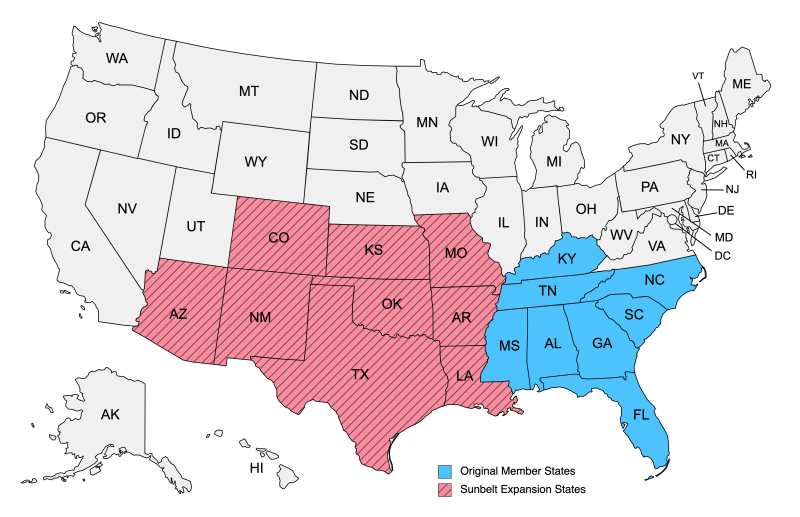
The purpose of the center is to consolidate information between states and provide intelligence drawn from drug data and research efforts. It aims to increase the efficiency and effectiveness of government organizations, law enforcement, non-profit organizations, public leaders, and the scientific community by enriching their information and facilitating collaboration.
The center aims to become a central hub that links data, conducts analyses, develops digital tools and data-sharing abilities, and disseminates relevant and updated knowledge to decision-makers, affected communities, and stakeholders for the broader region. The resulting repository will allow the identification of patterns in substance use that cross state borders and that occur between a broad set of drug-related factors.
Our Mission
To make privacy-protected, secured drug data, actionable intelligence, and focused strategies accessible to all.
What We Do
- Data Repository: We aggregate opioid and drug-related data from across the Southern US, as well as data pertaining to the social determinants of health, into a single, accessible platform.
- In-Depth Analysis: We conduct detailed analyses to identify trends and patterns in substance use.
- Digital Tools Development: We create and provide advanced tools for data visualization and sharing.
- Actionable Insights: Our platform delivers real-time insights and resources to support decision-making.
- Collaborative Support: We partner with government bodies, law enforcement, community organizations, and researchers to enhance their capacity to address drug-related challenges.
The DDRC Team
SR-DDRC Objectives
- Create a drug data repository that includes data from AL, FL, GA, KY, MS, NC, SC, and TN to produce and disseminate web-based, real-time, actionable multisector drug data. Later modified to include public data from the nine states of AR, AZ, CO, KS, LA, MO, NM, OK, and TX.
- Develop resources for other regions proactively wanting to build field knowledge and capacity in drug misuse and abuse by creating a regional SR-DDRC.
- Promote the analytic capacity among stakeholders in the government workforce, community, and other sectors involved in investigations to combat drug misuse and abuse.
- Develop and implement a research protocol for SR-DDRC so that research scholars can conduct policy-relevant analyses using stakeholder data to assist in combating drug misuse and abuse.
Our Vision
A southern US region using actionable drug data to inform public, private, and community efforts to address the opioid crisis, showing decreases in the use and overdose from opioids, informed decision-makers, new programs targeted to highest-need communities, and reductions in crime and trafficking, that serves as a model for other centers.