
DDRC Update - Drug Information
Alert: Internal Variations in Drug Potency: “The Chocolate Chip Cookie” Effect
Published on June 13, 2026
Drug checking data provides a reliable idea of the overall proportions of substances that are circulating in communities or even in specific samples, but on a harm reduction level, these numbers don’t reveal the risk within a specific dose. This is due to what some call the “chocolate chip cookie effect,” in which fentanyl mixes unevenly throughout a drug batch much like chocolate chips settle unevenly throughout cookie dough. As a result, one dose from a batch may contain little to no fentanyl while another dose from that same batch may contain a lethal amount. The SR-DDRC prepared this update to alert users to the public health concern and highlight the importance of fentanyl test strips to detect the presence of fentanyl.
The New York State Department of Health described how this phenomenon comes to be. Illicit drugs are not accurately mixed, so different parts of the same sample can contain vastly different concentrations of a substance or its adulterants. In their discussion of fentanyl test strips, The California Department of Public Health warned that fentanyl mixed into other drugs is never evenly distributed, meaning one side of a baggie could contain no fentanyl while the other contains a fatal dose.
Researchers offered a more detailed explanation in a 2024 study from Harm Reduction Journal. True "hot spots,” or portions of a sample with dramatically elevated fentanyl concentrations, proved to be rare, but the study found that fentanyl concentration still varied meaningfully between subsamples, distributed around a mean rather than uniformly throughout. The risk of failing to detect fentanyl at all was low, but accurately quantifying how much was present in any given portion emerged as a persistent challenge.
Because of this, people should remember that the amount of fentanyl present in any dose may vary to a lethal level and test strips are not a guaranteed way to measure risk.
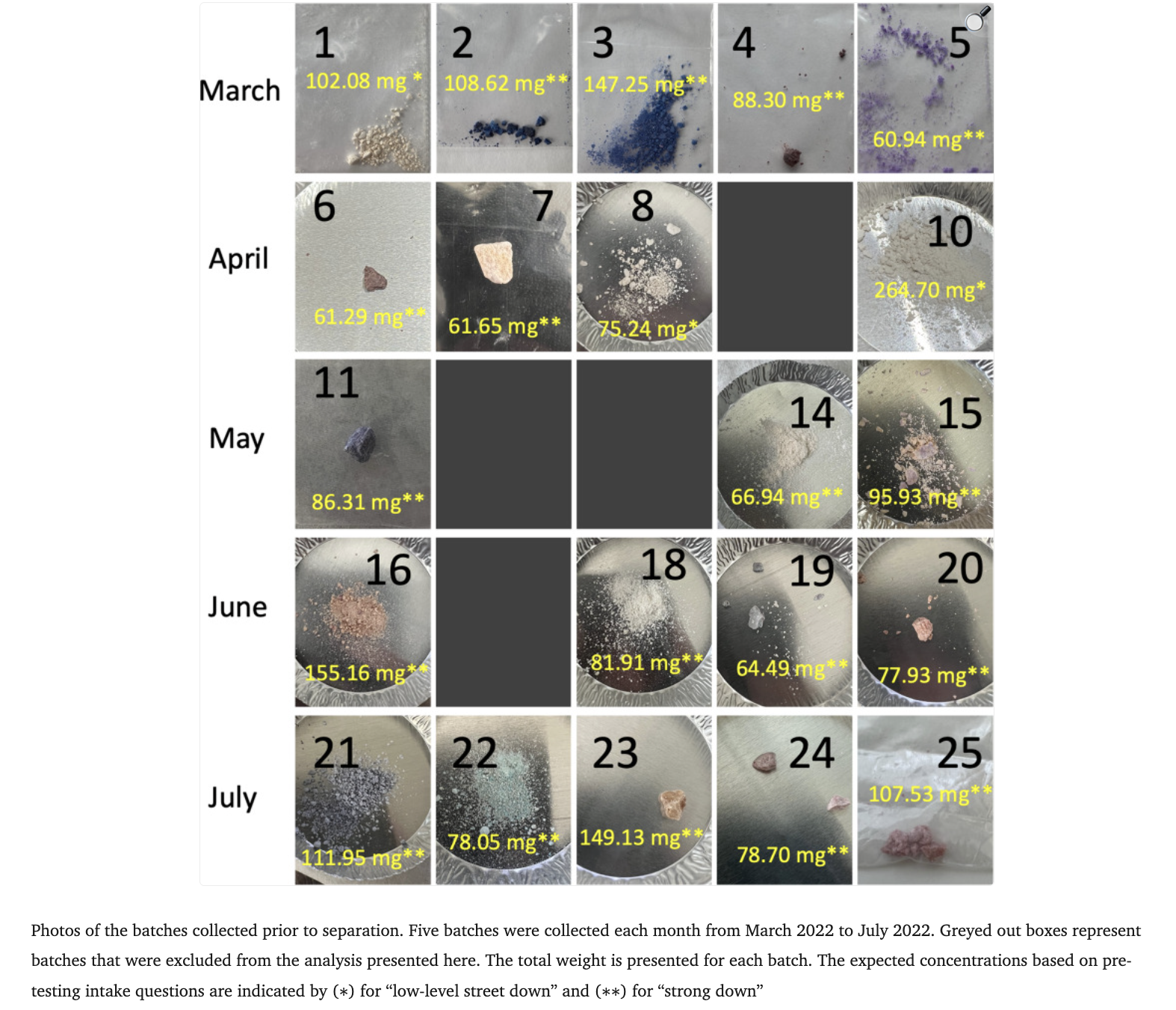
Graphic source: Gozdzialski, L., R. Louw, C. Kielty, A. Margolese, E. Poarch, M. Sherman, F. Cameron, C. Gill, B. Wallace, and D. Hore. 2024. "Beyond a Spec: Assessing Heterogeneity in the Unregulated Opioid Supply." Harm Reduction Journal 21 (1): 63. Retrieved June 13, 2026, from https://doi.org/10.1186/s12954-024-00980-5.
In this study, researchers studied 25 street samples of fentanyl (50–100 mg each). They broke each sample down into 5mg to test if the strength was consistent throughout the exact same bag. The consistency between batches varied greatly. In one bag, the strength fluctuated from 10% to 72% fentanyl depending on which sample they tested. In another bag, the strength was tightly mixed, staying between 4% and 9%.
A separate 2025 study published in Harm Reduction Journal shifted focus from the drug sample itself to the instructions used to test it. They found that the instructions people use to test their drugs are not standardized. Researchers analyzed 16 sets of fentanyl test strip instructions available online and found significant variation in testing methods, dilution recommendations, wait times, and how results should be interpreted. Only about half of the instructions addressed the chocolate chip cookie effect at all. The authors concluded that inconsistent instructions could lead to confusion, false confidence in test results, or disengagement from drug checking altogether.
Given the limitations of pre-use testing, some researchers have looked at alternative approaches entirely. A 2023 study from Harm Reduction Journal explored an alternative approach: testing urine after drug use, rather than testing the drug itself beforehand. While this method cannot prevent an overdose from the dose already taken, researchers found it could still influence overdose risk in the future. When people learned their urine tested positive for fentanyl when they had not expected it, the experience heightened their awareness of risk in a way that population-level warnings had not. Some responded by warning others using the same batch, keeping naloxone closer at hand, or reconsidering how much to use at once. The authors suggest that medical clinics, methadone programs, and other settings that already conduct urinalysis could play a larger harm reduction role simply by sharing those results in a supportive way, not as a substitute for pre-use testing, but as a tool for informing the decisions that follow.
Population-level drug checking data can track broad trends, but cannot account for what any individual dose contains. Street-level drug manufacturing is, of course, unregulated, and no single test can predict what the next portion of the same bag holds. When the instructions guiding that test are themselves inconsistent, the margin for error widens further. For the person on the receiving end of that variability, the difference between a well-mixed sample and a poorly-mixed one can be the difference between life and death.
For full analyses, please see the following links:
- “Beyond a Spec: Assessing Heterogeneity in the Unregulated Opioid Supply”: https://pmc.ncbi.nlm.nih.gov/articles/PMC10941387/
- California Department of Public Health: https://www.cdph.ca.gov/Programs/CCDPHP/sapb/Pages/Fentanyl.aspx
- “Highlighting Variability in Fentanyl Test Strip Instructions Using Thematic Content Analysis”: https://doi.org/10.1186/s12954-025-01252-6
- “Just Another Thing for Me to Stress Off Of”: Responses to Unintentional Fentanyl Use in a Community-Based Study of People Who Use Opioids”: https://doi.org/10.1186/s12954-023-00863-1
- New York State Department of Health: https://www.health.ny.gov/diseases/aids/consumers/prevention/oduh/faqs.htm
References
California Department of Public Health. 2026. "Fentanyl." Retrieved June 13, 2026, from https://www.cdph.ca.gov/Programs/CCDPHP/sapb/Pages/Fentanyl.aspx.
Gozdzialski, L., R. Louw, C. Kielty, A. Margolese, E. Poarch, M. Sherman, F. Cameron, C. Gill, B. Wallace, and D. Hore. 2024. "Beyond a Spec: Assessing Heterogeneity in the Unregulated Opioid Supply." Harm Reduction Journal 21 (1): 63. Retrieved June 13, 2026, from https://doi.org/10.1186/s12954-024-00980-5.
Lorvick, Jennifer, Jordana L. Hemberg, Madeleine J. George, Joy R. Piontak, and Megan L. Comfort. 2023. "“Just Another Thing for Me to Stress Off Of”: Responses to Unintentional Fentanyl Use in a Community-Based Study of People Who Use Opioids." Harm Reduction Journal 20 (1): 134. Retrieved June 13, 2026, from https://doi.org/10.1186/s12954-023-00863-1.
New York State Department of Health. 2026. "Fentanyl: Frequently Asked Questions." Retrieved June 13, 2026, from https://www.health.ny.gov/diseases/aids/consumers/prevention/oduh/faqs.htm.
Piercey, Cianna J., Claire L. Pince, and Hollis C. Karoly. 2025. "Highlighting Variability in Fentanyl Test Strip Instructions Using Thematic Content Analysis." Harm Reduction Journal 22 (1): 110. Retrieved June 13, 2026, from https://doi.org/10.1186/s12954-025-01252-6.
Tags
Alabama Arizona Arkansas Colorado Florida Georgia Kentucky Louisiana Mississippi Missouri National Nebraska New Mexico North Carolina Oklahoma South Carolina Tennessee Texas Fentanyl Harm Reduction