
DDRC Update - News & Updates
CDC Health Advisory: Increase in Medetomidine Detection in U.S.
Data Source Centers for Disease Control and Prevention (CDC) on June 12, 2026
The Centers for Disease Control and Prevention (CDC) and the White House Office of National Drug Control Policy (ONDCP) is alerting the U.S. public about increasing detections of medetomidine. This veterinary sedative, also known as “rhino tranq,” “mede,” or “dex,” raises concerns about severe withdrawal syndrome upon exposure. The SR-DDRC prepared this update to ensure practitioners working in the substance use disorder space would get this important information.
According to the CDC, medetomidine is synthesized in clandestine laboratories and mixed almost exclusively with fentanyl, often without users' knowledge. Lab reports from law enforcement seizures tracked through the National Forensic Laboratory Information System rose by 950% between 2023 and 2024, then by an additional 215% in 2025, with the highest concentrations in the Northeast and Midwest.
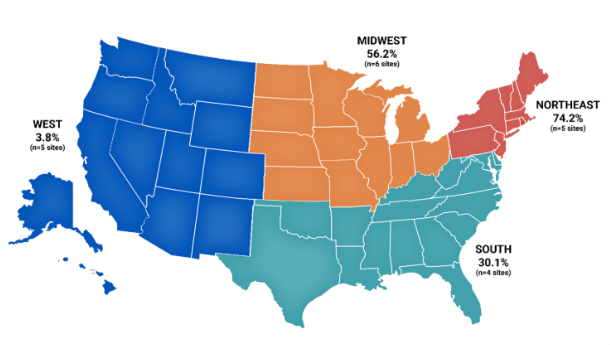

Graph source: Centers for Disease Control and Prevention. April 2, 2026. "Medetomidine in the U.S. Illegal Fentanyl Supply Increasing Risk for Overdose and Severe Withdrawal Syndrome." CDC Health Alert Network. Retrieved June 12, 2026, from https://www.cdc.gov/han/php/notices/han00527.html.
The drug creates a two-sided danger for people exposed to it. As a potent tranquilizer, medetomidine causes profound and often prolonged sedation, severely slowed heart rate, and low blood pressure. While naloxone can still reverse the opioid component of an overdose and restore breathing, it is not effective on medetomidine or its effects. On the other side, stopping medetomidine after regular use can trigger a severe withdrawal syndrome, similar to clonidine withdrawal, with symptoms including dangerously high blood pressure, rapid heart rate, chest pain, fluctuating consciousness, and uncontrollable nausea and vomiting that can require emergency or intensive care.
This creates significant challenges for first responders and clinicians. Standard drug screens do not typically test for medetomidine, making it difficult to identify in overdose cases. That said, a cluster of overdoses in Chicago in May 2024 were found to have at least 178 confirmed, probable, or suspected medetomidine-involved cases, at least 16 hospitalizations, and 1 death.
To read the full advisory and recommendations for public health professionals, clinicians, laboratories, and people at risk for overdose, please visit the CDC Health Alert Network (HAN) notice at the following link: https://www.cdc.gov/han/php/notices/han00527.html
References
Centers for Disease Control and Prevention. April 2, 2026. "Medetomidine in the U.S. Illegal Fentanyl Supply Increasing Risk for Overdose and Severe Withdrawal Syndrome." CDC Health Alert Network. Retrieved June 17, 2026, from https://www.cdc.gov/han/php/notices/han00527.html.
Tags
Alabama Arizona Arkansas Colorado Florida Georgia Kentucky Louisiana Mississippi Missouri National Nebraska New Mexico North Carolina Oklahoma South Carolina Tennessee Texas Fentanyl Medetomidine