
DDRC Update - Drug Information
KFF: Opioid Overdose Trends Decreased Between 2023-2024
Data Source Centers for Disease Control and Prevention (CDC) on February 24, 2026
According to a recent KFF analysis, opioid overdose death trends have notably decreased between 2023 and 2024, bringing the number of opioid overdose deaths closer to pre-pandemic levels.
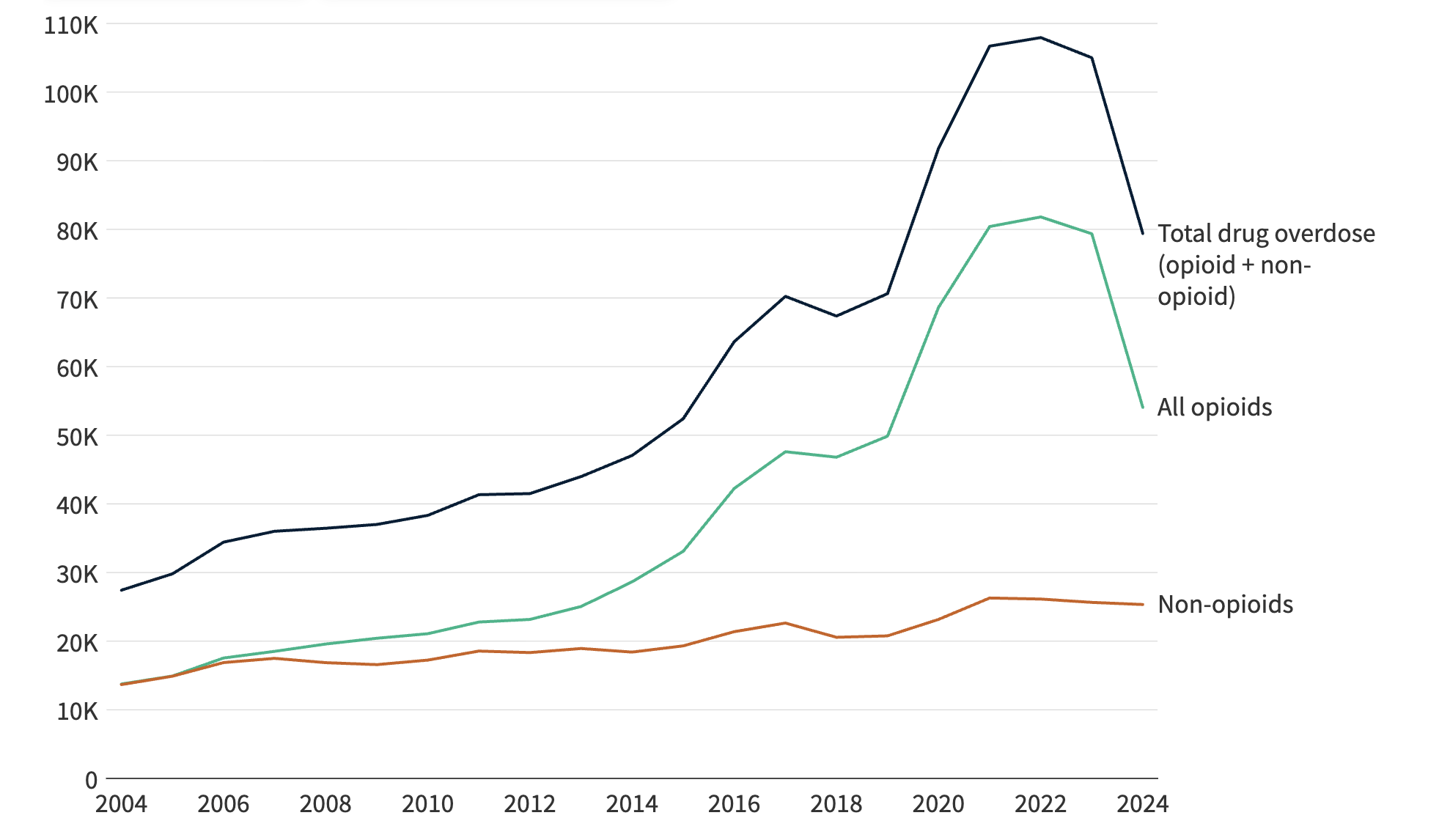
Graph source: Saunders, Heidi, Nirmita Panchal, and Robin Rudowitz. 2026. "Opioid Overdose Deaths: National Trends and Variation by Demographics and States." KFF. Retrieved June 8, 2026, from https://www.kff.org/mental-health/opioid-overdose-deaths-national-trends-and-variation-by-demographics-and-states/.
Data from the Centers for Disease Control and Prevention (CDC) indicated that total opioid overdose deaths were 31.8% lower in 2024 than in 2023. This reduction was primarily attributed to multiple policy actions including expanded treatment access and increased border detection.
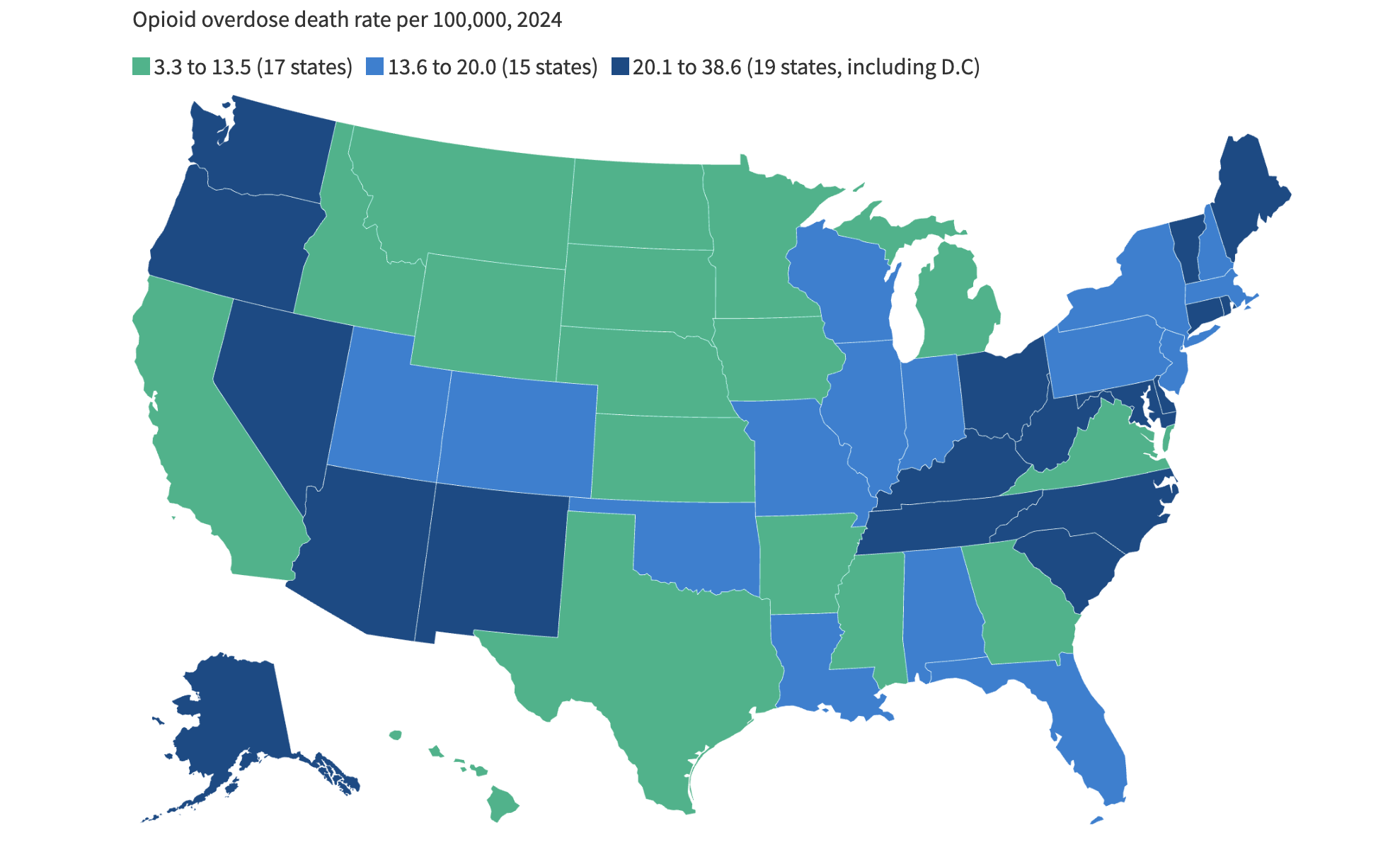
Graph source: Saunders, Heidi, Nirmita Panchal, and Robin Rudowitz. 2026. "Opioid Overdose Deaths: National Trends and Variation by Demographics and States." KFF. Retrieved June 8, 2026, from https://www.kff.org/mental-health/opioid-overdose-deaths-national-trends-and-variation-by-demographics-and-states/.
Though all overdose death rates declined from 2023 to 2024, KFF reports percentages varied across different regions and demographics. In 2024, state rates ranged from 3.3 per 100,000 (Nebraska) to 38.6 per 100,000 (West Virginia). Overdose death rates remain high among American Indian/Alaska Native (AIAN) people, Black people, and males. However, every demographic group achieved progress, with Black and Hispanic groups seeing the steepest decline in overdose deaths. According to the National Center for Health Statistics data brief, these declines occurred across all examined opioid types. Fatalities involving synthetic opioids decreased the most with a 35.6% drop, while heroin death rates fell by 33.3%, natural and semisynthetic opioid deaths declined by 20.7%, and methadone-involved rates decreased by 10.0%.
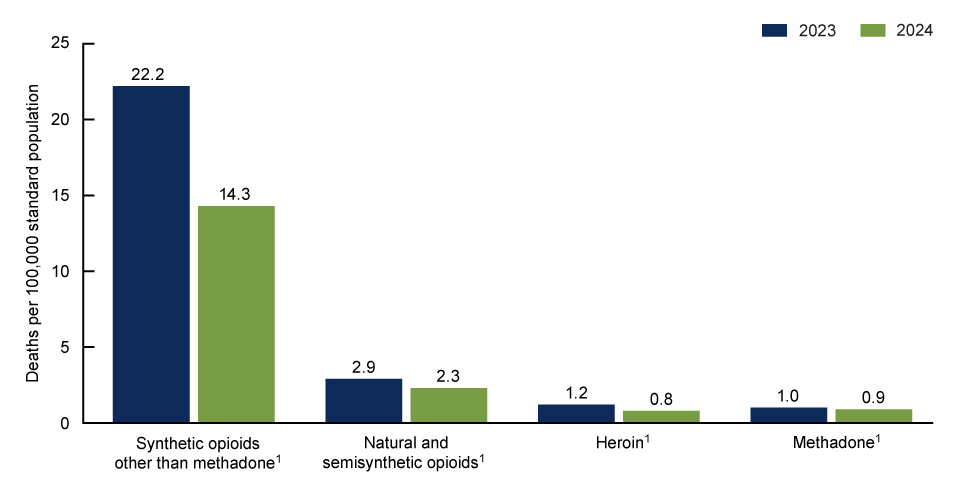
Graph Source: Garnett, Matthew F., and Arialdi M. Miniño. January 2026. "Drug Overdose Deaths in the United States, 2023–2024." NCHS Data Brief, no. 549. Hyattsville, MD: National Center for Health Statistics. Retrieved June 8, 2026, from https://www.cdc.gov/nchs/products/databriefs/db549.htm.
KFF cautions that while the current decline is promising, future trends remain highly uncertain. Progress could be impacted by recent federal policy shifts: budget and staffing cuts, Medicaid changes, and an enforcement-focused pivot designating fentanyl as a 'Weapon of Mass Destruction.' Additionally, slower declines among older adults highlight ongoing challenges in detecting and treating substance use disorders in aging populations.
Ultimately, these KFF findings show that while the 2024 decline is promising, about half of states remain above 2019 levels which may reflect differences in state policy and the timing of fentanyl's spread. Moving forward, future trends may be affected by federal funding and enforcement, highlighting the ongoing challenge of sustaining these declines across different states and populations.
For the full analysis, please visit the article by the KFF at the following link: https://www.kff.org/mental-health/opioid-overdose-deaths-national-trends-and-variation-by-demographics-and-states/
References
Garnett, Matthew F., and Arialdi M. Miniño. January 2026. "Drug Overdose Deaths in the United States, 2023–2024." NCHS Data Brief, no. 549. Hyattsville, MD: National Center for Health Statistics. Retrieved June 8, 2026, from https://www.cdc.gov/nchs/products/databriefs/db549.htm.
Saunders, Heidi, Nirmita Panchal, and Robin Rudowitz. 2026. "Opioid Overdose Deaths: National Trends and Variation by Demographics and States." KFF. Retrieved June 8, 2026, from https://www.kff.org/mental-health/opioid-overdose-deaths-national-trends-and-variation-by-demographics-and-states/.
Tags
Alabama Arizona Arkansas Colorado Florida Georgia Kentucky Louisiana Mississippi Missouri National Nebraska New Mexico North Carolina Oklahoma South Carolina Tennessee Texas Drug Overdose Opioids